
Library: Resources & Media
Press Releases

Kevin Biller Inducted into Powder Coating Institute Hall of Fame
The ChemQuest Group is pleased to announce that Kevin Biller, director of ChemQuest Powder Coating Research, was inducted into the Powder Coating Institute (PCI) Hall of Fame at the conclusion of the organization’s annual meeting on May 30.

Heshmatazad Joins ChemQuest as a Director
The ChemQuest Group is pleased to announce the appointment of Roudabeh (Rudi) Heshmatazad as a director. Heshmatazad is a strategic and forward-thinking business leader with decades of experience translating consumer insight into innovative, market-winning products. Known for building and expanding portfolios through a deep understanding of market dynamics, data analytics, and consumer behavior, she excels in driving cross-functional collaboration across R&D, marketing, and operations to deliver impactful, scalable solutions.

ChemQuest Broadens Bench with New Directors to Support Global Growth
The ChemQuest Group is pleased to announce the appointment of five new directors with diverse expertise who will support specialty materials clients with tailored business strategy and optimization, technology acceleration, market intelligence, and M&A advisory services. New to the global consulting firm are: Sanjeev Dey, Ph.D.; Marc de Pater; Henry DiGregorio; Arpit Dwivedi; and Frederick Myers, Ph.D.
Market Reports
U.S. Market Analysis for the Paint & Coatings Industry (2023 – 2028)

Global Market Analysis for the Paint & Coatings Industry (2024 – 2029)

Articles

ChemQuest Q&A: Philip Marsh
From a university internship to his current position on ChemQuest’s global business development team, Philip Marsh’s career seems to have come full circle. He has built on the extensive capabilities he garnered in managing external channel distributor networks to drive successes in new product development, production startups, M&A, and global business leadership. A UK native and current resident of the Netherlands, Philip also utilizes his expertise in support of client projects around the world.

Geopolitics and the Global Supply Chain: What’s Next?
As global trade fragments and regionalization accelerates, organizations will need to adopt differentiated structures and technology stacks—a one-size-fits-all approach will no longer suffice. More than anything else, we need to learn from the past, including from the recent, post-COVID past. Developing resilient and transparent supply chains is at the top of the list, when it comes to being prepared for geopolitical shifts that might affect global supply chains. This is closely followed by building a geopolitical view from the perspective of your own company.

Mastering Key Performance Indicators for Long-Term Success
Your company has undoubtedly developed key performance indicators (KPIs) for your operation. Depending on your specific products, facilities, personnel, etc., these KPIs likely focus on areas such as production volume, on-time delivery, production costs, and environmental health and safety (EH&S), among others. KPIs are important gauges of your company’s productivity and efficiency, but simply having KPIs does not guarantee success.

Mitigating Personnel Challenges through Strategic Partnerships
Personnel roles within specialty chemicals and advanced materials require specialized know-how and skills, making it incredibly difficult to find knowledgeable and experienced people to fill key positions. Unfortunately, not having fully staffed and skilled teams in place jeopardizes your company’s ability to succeed over the long term. How many potentially impactful initiatives have been abandoned due to a lack of internal resources? Too many, without a doubt.

Salt Spray Testing: Dinosaur or Foundational Benchmark?
First published in 1939, one of the oldest specifications in the Committee D01 arsenal is ASTM B117 Standard Practice for Operating Salt Spray (Fog) Apparatus. It is still in active use today in a variety of markets to evaluate the comparative durability and performance of substrates in corrosive environments. This is despite some experts suggesting that the test is outdated and convenient rather than scientifically rigorous.
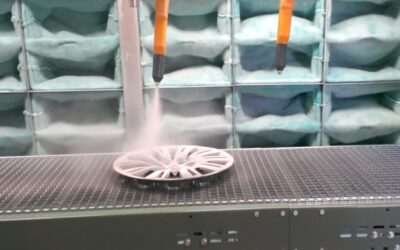
Powder Coating Nonconductive Substrates
Powder coating is traditionally applied electrostatically to a conductive (typically metal) substrate. The charged particles are attracted to the grounded object and uniformly deposited on the surface. However, as low-temperature-cure powder coatings become more available, the possibility of using them for coating a wide variety of heat-sensitive and nonconductive substrates is more of a reality than ever before.
Videos


Podcast
Webinars