

Table of Contents
Understanding the forces shaping the paints and coatings industry requires looking beyond short-term market fluctuations to the larger societal and technological trends that influence innovation and demand. While economic cycles, supply chain disruptions, and geopolitical shifts affect the industry in the near term, long-term megatrends continue to guide the direction of coatings technology, investment priorities, and strategic decision making.
In this blog series, we’ll explore several pertinent megatrends, including digitalization, sustainability, mobility, and health awareness. In this first installment, we dig into how urbanization and globalization are impacting the global coatings industry.
Urbanization
Urbanization — the shift of populations from rural to urban areas — remains a powerful driver of growth for architectural and infrastructure coatings. As cities expand and infrastructure ages, demand for durable coatings that protect buildings, bridges, and transportation systems will continue to increase.
Asia is currently home to seven of the world’s top 10 megacities (i.e., urban agglomerations with over 10 million inhabitants, as defined by the United Nations). This rapid urbanization is transforming city landscapes and, with that, reshaping the requirements and opportunities within the coatings industry.
Occupying an estimated 42% of the global architectural coatings market by value, the Asia-Pacific (APAC) region represents a sizeable and growing opportunity for new technologies (see Figure 1).
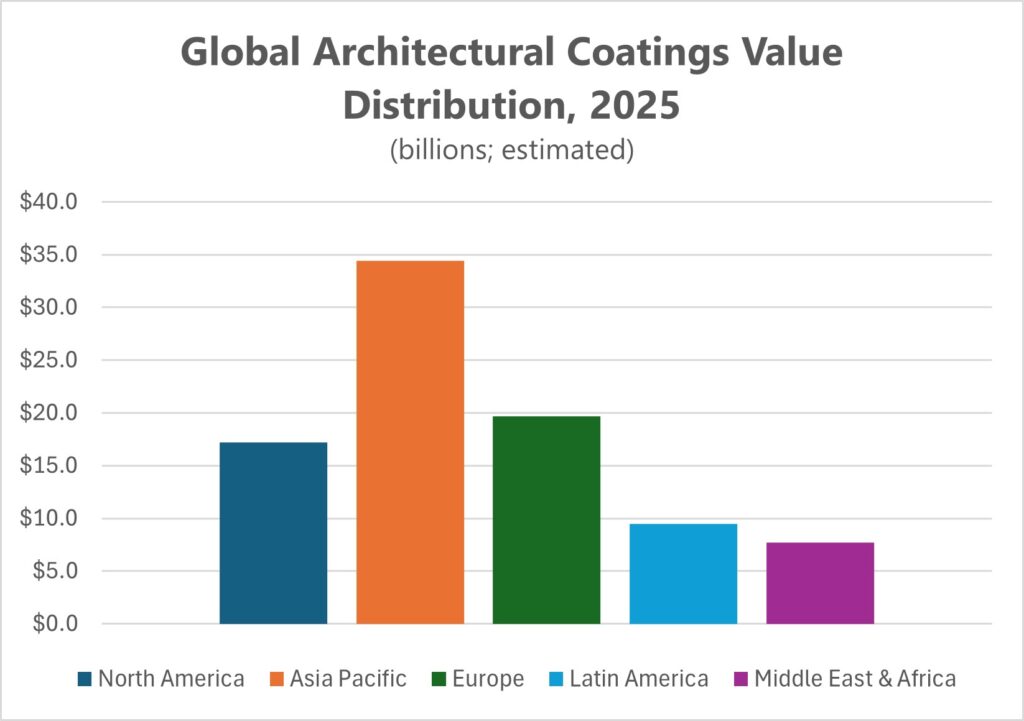
(Source: The ChemQuest Group, Inc.)
As sprawling megacities face challenges like heavy vehicular emissions, acid rain, and accelerated wear on building materials, paint companies are innovating both their product formulations and application techniques to meet these new demands. Kansai Paint has focused on waterborne coatings that are reportedly both environmentally friendly (thanks to their low VOC content) and engineered for enhanced durability. These coatings are optimized for contemporary urban infrastructures such as high-rise apartment complexes and commercial centers, delivering superior resistance to weathering and pollutants common in cities like Tokyo, Jakarta, and Seoul.
Jotun has also introduced advanced exterior coatings tailored for polluted urban environments. According to the company, these coatings combine low-VOC profiles with self-cleaning properties that help reduce maintenance costs and enhance appearance over time. In cities like Singapore and Shanghai, Jotun’s products have been instrumental in supporting sustainable urban development by mitigating the adverse effects of industrial and vehicular emissions on city structures.
Nippon Paint has expanded its portfolio for urban applications by developing photocatalytic coatings. The company reports that these innovative formulations not only provide aesthetic appeal but also use photocatalysts to break down pollutants on building surfaces, thereby helping to improve air quality in densely populated cities. This technology is particularly useful for high-rise commercial and residential towers where constant exposure to urban pollutants accelerates degradation.
Demographics and Globalization
Demographic changes are also reshaping global markets. Aging populations in developed economies are influencing housing maintenance patterns, while rising middle-class populations in emerging markets are increasing demand for residential construction and consumer goods.
At the same time, globalization is evolving into a more complex dynamic often described as “glocalization.” Multinational coatings companies must adapt their products and strategies to meet regional regulatory requirements, climate conditions, and consumer preferences while maintaining global supply chains.
Our next post in this series will focus on digitalization’s role in reshaping the paints and coatings industry by driving faster R&D cycles, smarter manufacturing, and transformative innovation.
Contributors: Crystal Morrison, Ph.D.; Philip Marsh; Wayne Daniell, Ph.D.
How can we help you? Let’s start talking: https://chemquest.com/lets-start-talking/
