
AI, cloud computing, and digital transformation are fueling one of the largest construction booms in modern history. That’s an incredible opportunity, but it’s also creating unprecedented challenges for owners, contractors, and material suppliers.
The discussion around data centers has expanded well beyond building facilities faster. Operators today must reduce energy consumption, improve water efficiency, manage supply chain uncertainty, and deliver facilities that will operate reliably for decades. Every material specified — from structural steel to cooling systems — must contribute to that objective. Protective coatings are no exception.
Protective coatings have always been about preserving assets. They enable components to be protected before they arrive on site. They support fire safety, improve durability under demanding operating conditions, and help facilities withstand moisture, chemicals, abrasion, and temperature fluctuations. Properly selected coating systems also contribute to sustainability initiatives by extending service life, reducing maintenance, minimizing material replacement, and supporting compliance with increasingly demanding environmental regulations. Data centers, however, demand much more than corrosion resistance alone.
Understanding the Major Components of a Data Center
When most people think about a data center, they picture rows of server racks filled with blinking lights. Those servers are certainly the heart of the operation, but they’re only one piece of a much larger and more sophisticated system. Every data center relies on a network of supporting infrastructure that keeps the equipment operating continuously, often 24 hours a day, seven days a week.
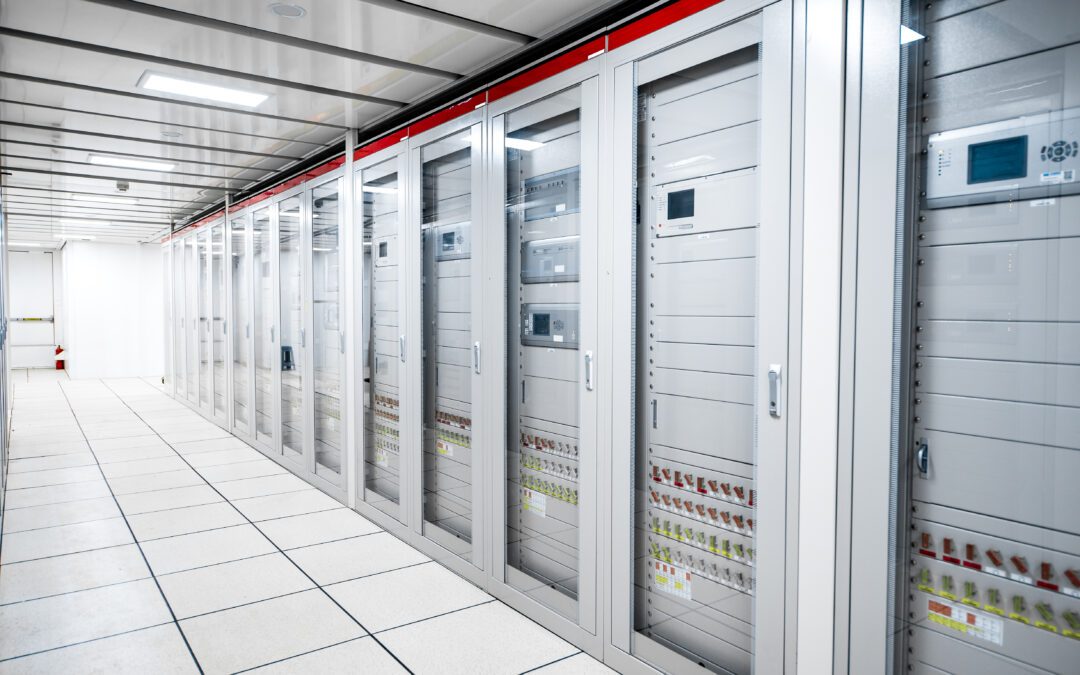
The IT equipment includes servers that perform the computing, storage systems that securely hold enormous amounts of data, and networking hardware (e.g., switches, routers, firewalls, and load balancers). In turn, these components allow information to move quickly and securely throughout the facility and around the world.Reliable power is essential. Data centers depend on utility power backed by uninterruptible power supplies (UPSs), power distribution units (PDUs), and emergency generators to ensure that even a brief interruption doesn’t result in downtime. Many of these components are housed in steel enclosures and cabinets that require durable finishes capable of protecting against corrosion while providing an attractive, long-lasting appearance. Powder coatings have become the finish of choice for many of these applications because of their durability, efficiency and environmental advantages.
Managing heat is another constant challenge. Servers generate tremendous amounts of heat, making cooling systems every bit as critical as the computing equipment itself. From computer room air conditioners (CRACs) and computer room air handlers (CRAHs) to traditional HVAC systems and containment systems, as well as, increasingly, liquid cooling technologies, all work together to maintain precise operating temperatures. The cabinets, ductwork, cooling equipment, and support structures that make up these systems also benefit from high-performance coating systems that are able to withstand demanding operating environments.
Finally, redundancy is built into virtually every critical system. Whether it’s power, cooling, or networking, most facilities are designed with backup capacity, so operations continue even if a component fails or requires maintenance. In the world of data centers, uninterrupted operation is an expectation.
Why Powder Coatings Matter in Data Centers
Powder coating has become the preferred finish for many data center components because it provides a combination of durability, corrosion protection, appearance, and environmental performance that is difficult for conventional liquid coatings to match. Whether components are exposed to outdoor weather, high humidity, or changing environmental conditions, a properly selected and applied powder coating provides a durable barrier against corrosion. This is especially important for exterior equipment, structural members, security fencing, cooling equipment, and backup power systems that are expected to provide decades of reliable service.
Throughout the life of a data center, equipment is installed, upgraded, and serviced regularly. Cabinets, racks, doors and enclosures are frequently moved, opened, or handled, creating countless opportunities for abrasion and impact. Powder coatings offer excellent resistance to chipping, scratching, and wear, ensuring these components maintain their appearance and protective performance over time.
Appearance may seem secondary in a mission-critical facility, but it is important. A clean, uniform, high-quality finish reflects the attention to detail and quality expected throughout the entire operation. Powder coatings retain their color and finish well for many years, with very little maintenance.
Powder coatings make the most difference when used on fabricated steel elements such as server racks, cabinets, and IT cages, which must protect the internal computing equipment but also withstand continual hands-on maintenance. For similar reasons, electrical enclosures, switchgear, power distribution equipment, and UPS cabinets also benefit from such coatings, in addition to corrosion resistance and optimal appearance requirements.
Outside the building, powder coatings are also widely used on generator enclosures, cooling equipment, HVAC systems, battery storage enclosures, and other environmental control equipment. These components operate in every extremity of weather, and long-term durability and corrosion protection are essential. To that same end, powder coatings are also employed for security fencing, access gates, bollards, and protective barriers.
Less noticeable — but no less important — are cable trays, wire management systems, equipment supports, and structural framework. These components may not be seen once a facility is operating, but they are expected to provide reliable service throughout the life of the data center. Finally, powder coatings are increasingly specified for architectural and structural steel, including stairways, handrails, catwalks, mezzanines, equipment platforms, and other fabricated metalwork.
The common thread running through all these applications is reliability. Data centers are built with the expectation that they will operate continuously for decades with minimal interruption. Powder coatings help support that goal by protecting the steel components that make up much of the facility’s infrastructure. While they may not be the most visible part of a data center, they are an important contributor to its long-term performance, durability, and overall value.
Performance Drives Specifications
Winning business in the data center market is about much more than supplying powder coating. OEMs evaluate suppliers on their ability to deliver consistent quality, provide technical support across multiple manufacturing locations, maintain reliable supply chains, and offer products that perform over decades of service.
For interior applications like server racks, electrical enclosures, switchgear, and network cabinets, epoxy-polyester hybrid powders remain one of the most widely specified technologies. They provide an excellent combination of appearance, scratch resistance, chemical resistance, and overall durability in controlled indoor environments.
Exterior applications present a different challenge. Generator enclosures, battery energy storage systems, and exposed structural components require powder coatings capable of withstanding sunlight, moisture, temperature fluctuations, and corrosion. In these applications, super-durable polyester systems have become the preferred choice because they provide optimal weatherability and long-term color retention.
Duplex Coating Systems
One of the most effective ways to protect any component in a demanding environment is to combine two proven technologies: hot-dip galvanizing and powder coating. This combination, commonly referred to as a duplex coating system, has been used successfully for many years in applications where long-term corrosion protection is essential.
Each coating contributes something different. The galvanized coating provides sacrificial corrosion protection by shielding the steel from the environment, even if the surface is scratched or damaged. The powder coating serves as a durable barrier that further limits exposure to moisture and corrosive elements while providing the color, gloss, and overall appearance expected in today’s facilities.
For data centers, this approach is particularly attractive for exterior applications exposed to the elements, including security fencing, structural steel, equipment supports, cooling infrastructure, and generator enclosures. Duplex systems are especially well-suited for facilities located in coastal regions where salinity is high, areas with high humidity, industrial locations where airborne contaminants are present, or anywhere steel is subjected to aggressive weather conditions.
Water Management and Fire Protection
As large-scale infrastructural footprints, data centers depend on increasingly sophisticated cooling systems to manage the enormous heat they generate. As operators work to improve water usage effectiveness (WUE), which calculates the ratio of the water consumed by a facility for cooling, humidification, etc. to the total energy consumed by its IT equipment, cooling water systems, storage tanks, containment structures, and wastewater infrastructure become even more critical.
These environments expose concrete and steel to continuous moisture, aggressive chemicals, abrasion, and thermal cycling. Selecting the proper coating system is essential for protecting these assets.
Immersion-grade epoxy coatings, elastomeric linings, and other high-performance protective systems help maintain the integrity of tanks, piping, tunnels, and secondary containment structures. Failure of these systems can lead to unplanned downtime, costly repairs, environmental concerns, and regulatory compliance issues.
The growing use of multistory data centers, particularly in urban markets where available land is limited, has also led to a redoubled need for robust fire protection measures. In centers of this kind, personnel commonly occupy spaces adjacent to server operations.
Intumescent fire-protective coatings are increasingly specified to provide multi-hour fire resistance for structural steel. During a fire, these coatings expand to form an insulating char that slows heat transfer, allowing the steel structure to maintain its strength longer. Those additional minutes make a major difference for safe evacuation, emergency response, and protecting valuable equipment.
Many European facilities have required higher fire-resistance ratings for years. As global data center operators apply common design standards across multiple regions, similar performance expectations are becoming more common throughout North America.
Looking Ahead
The explosive growth of AI and hyperscale data centers is changing the expectations placed on virtually every component that goes into these facilities, including protective coatings. For years, coatings used on server racks, electrical enclosures, cooling equipment, and support structures were expected to do two things well: Protect metal from corrosion and provide a durable, attractive finish. Those requirements haven’t changed, but they are no longer the whole story.
Today, powder coatings are becoming part of the overall engineering solution. OEMs are asking suppliers to help improve manufacturing efficiency, support sustainability goals, extend equipment life, and, in some applications, even contribute to thermal and electrical performance.
Heat Management
As rack densities grow, operating temperatures will increase. While powder coatings were not initially intended to dissipate heat, they must continue to perform after years of thermal cycling without losing adhesion, gloss, color stability, or mechanical integrity. That means resin technology will continue to evolve to provide better long-term durability under increasingly demanding service conditions.
Cooling Systems
Liquid-cooled systems that use chilled water, glycol solutions, dielectric fluids, and even immersion cooling expose coated components to environments that were uncommon only a few years ago. Future powder coatings will need greater resistance to moisture, chemicals, and continuous exposure to cooling fluids while continuing to protect welded assemblies, fittings, and fabricated steel from corrosion. In many outdoor or high-moisture applications, duplex coating systems that combine galvanizing with powder coating will become even more valuable.
Sustainability
While powder coatings already offer significant environmental advantages because they contain little or no volatile organic compounds (VOCs) and achieve high material utilization, swiftly evolving emissions reduction standards will also demand a reduction in the energy required to manufacture coated products. Low-temperature-cure powders are a good example. By lowering cure temperatures, manufacturers can reduce oven energy consumption, increase production throughput, and coat thinner materials with less risk of distortion. It’s one of the fastest-growing areas of development because it benefits both the environment and the manufacturers’ bottom lines.
The industry is also turning toward PFAS-free technologies, renewable raw materials, lower embodied carbon, Environmental Product Declarations, and life cycle assessments. As data center owners pursue aggressive environmental goals, coating systems that can document their sustainability performance will become increasingly valuable.
Electrical Performance
While powder coatings do offer excellent electrical insulation, certain applications within data centers may benefit from coatings engineered with controlled electrical properties that help dissipate static electricity or work in conjunction with grounding systems. These technologies are still emerging and illustrate how coatings are becoming increasingly functional rather than simply decorative.
Multifunctional Coatings
Researchers are evaluating additives such as ceramic materials, graphite, graphene, boron nitride, and aluminum nitride to determine whether powder coatings can assist with heat management in specialized applications. Other research is focused on self-healing technologies that can reduce corrosion after minor surface damage and smart coatings capable of detecting moisture, corrosion, overheating, or mechanical damage before failures occur.
Moreover, as many data center components are prefabricated and assembled on site, densely salinated air during ocean transport, desert temperatures, tropical humidity, or industrial pollution are all risk factors in transit. Consequently, coating specifications are increasingly demanding higher corrosion resistance, improved edge protection, better UV durability, and greater resistance to abrasion during shipping and installation.
An Exciting Future
As demand for data centers continues to accelerate, designers and manufacturers are placing greater emphasis on materials that offer long service life, lower maintenance costs, and sustainable manufacturing practices. Powder coating checks all those boxes.
Future coatings won’t simply resist corrosion and look good. They’ll help manufacturers build more efficiently and sustainably while supporting critical infrastructure in performing more reliably over decades of service. For an industry built around uptime and long-term reliability, that’s an exciting future for powder coatings.
Read in Products Finishing.
How can we help you? Let’s start talking: https://chemquest.com/lets-start-talking/
